

 Have a question?
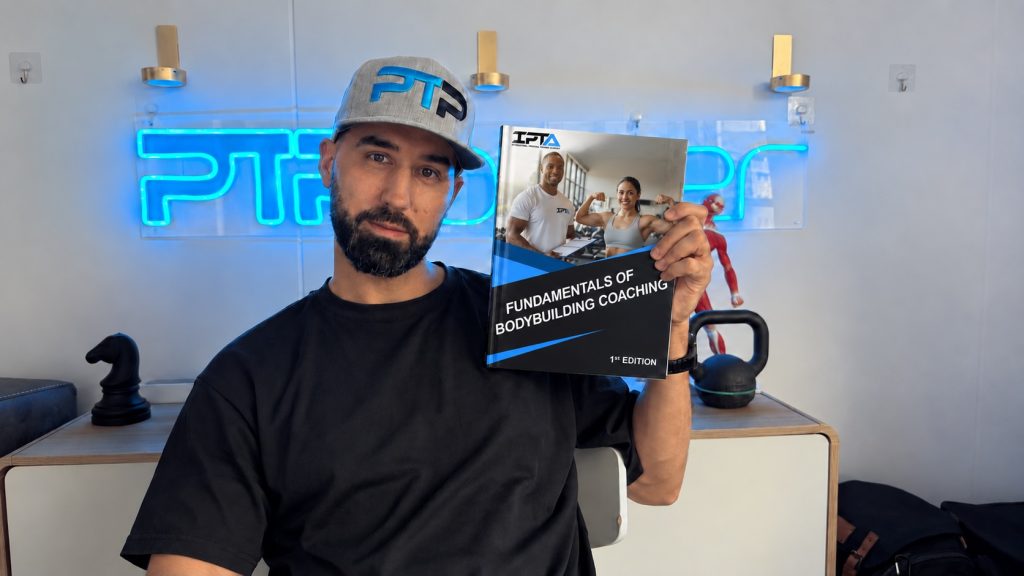
The IPTA Certified Bodybuilding Specialist (CBS) is worth it for coaches who want to build, cut and peak physiques, and the $799 MVP package is the one to buy. IPTA (International Personal Trainer Academy) sells it in two packages: Rookie at $399, and MVP at $799, which adds the NCCA accredited IPTA CPT.
In this review I walk through the 733-page textbook domain by domain, the exam and blueprint, the Rookie versus MVP packages, and how the CBS compares to NASM and ISSA.
If you are still deciding on which path fits your goals, take the quiz.

IPTA Certified Bodybuilding Specialist (CBS)
- Organization: IPTA (International Personal Trainer Academy)
- Credential: Certified Bodybuilding Specialist (CBS)
- Accreditation: MVP includes the NCCA accredited IPTA CPT
- Cost: Rookie $399 / MVP $799
- What you study with on Rookie: Digital textbook in the online reader, interactive study guide with quizzes, exam simulator, flashcard system
- Exam: 100 multiple choice questions, 2 hours, online, not proctored so open book, 70 percent to pass
- Retakes: Free and unlimited on MVP, $199 per retake on Rookie
- Average study time: 4 to 8 weeks, per IPTA
- Prerequisites: None
- Renewal: Every 2 years, $99; first renewal free on MVP
- CEUs: 23 toward IPTA CPT renewal
What is the IPTA CBS?
The IPTA CBS is IPTA’s bodybuilding specialty. It stands out for covering the full prep arc from foundations through peaking, plus the coaching psychology and business side of bodybuilding coaching.
The textbook is 733 pages with 15 chapters organized in six exam domains. The book frames bodybuilding as the Increase phase of IPTA’s PRIME model, where muscle is the end goal rather than a means. That context helps you see why the whole book points toward hypertrophy. PRIME is not exam content and you will not be tested on the phases.
It’s built for three kinds of reader: contest prep coaches who want a repeatable system for building and cutting, coaches whose lifestyle physique clients are prepping for a vacation or a photo shoot, and serious lifters who want a structured system for their own prep.
You don’t need a CPT to enroll. At the same time, the CBS does not replace a CPT for gym employment, and it does not replace a full nutrition credential.
Who the IPTA CBS is for (and who it Isn’t for)
- Trainers who coach physique or contest prep clients and want programming, peaking and psychology in one place
- CPT holders who want a hypertrophy specialty that also covers their IPTA CEUs
- Beginners who want a CPT too and like the idea of buying the specialty and the CPT together on MVP
- Competitors who want a structured system for their own prep and want to understand the why behind each phase
- Anyone who wants an entry level gym credential on its own. Get a CPT first, or choose MVP which includes it
- Someone who needs a full nutrition credential. The CBS covers nutrition and supplementation within a coaching scope only
- Buyers whose employer specifically asks for NASM on the job posting
If you see yourself in the left column, the CBS lines up well with your work. If you see yourself in the right column, you will be better served by starting with a CPT or by choosing the brand your target employer lists.
Is the IPTA CBS Worth It?
Yes, the IPTA CBS is worth it for the right reader, and that reader is a coach who will actually use physique programming, cutting and peaking.
I recommend it because it covers the entire arc in one curriculum. You get scientific foundations, hypertrophy methods and program design, nutrition and supplementation, assessments and contest prep, recovery and injury management, plus coaching psychology, client management and business skills. The scope line is also a strength. The book is explicit about where coaching stops and referral starts, which matters when clients ask about PEDs or about aggressive peak week tactics.
The $799 MVP makes the value case stronger than Rookie alone. For $799 you get the CBS plus the NCCA accredited IPTA CPT. You also get free and unlimited retakes, free first recertification plus one free continuing education course of your choice from over 100, and the full set of study tools. If you already hold a CPT, the CBS still gives you 23 CEUs toward your next IPTA CPT renewal and a system you can use for physique clients right away.
The honest limitation is that IPTA is newer than NASM and ISSA, so it has less name recognition. That can matter if a job posting names a specific brand.
The CBS also renews every two years for $99, while NASM’s Physique and Bodybuilding Coach does not expire at all. Free retakes are MVP only. And the CBS does not replace a full nutrition credential. If any of those is a deal breaker, read the comparison section below carefully. In my view, for most coaches who want to coach building, cutting and peaking, the content and the MVP bundle outweigh those limits.
Rookie vs MVP: What You Get
| Feature | Rookie $399 | MVP $799 |
|---|---|---|
| CBS exam and certification | Yes | Yes |
| Digital textbook in the online reader | Yes | Yes |
| Interactive study guide with quizzes | Yes | Yes |
| Exam simulator | Yes | Yes |
| Flashcard system, 145 flashcards | Yes | Yes |
| NCCA accredited IPTA CPT | No | Yes |
| Audio study guide | No | Yes |
| SurePass AI readiness prediction | No | Yes |
| Performance reporting and weak point training | No | Yes |
| Tailored study plans | No | Yes |
| Streaks and gamification | No | Yes |
| Magic mnemonics, 65 mnemonics | No | Yes |
| Exam date tracker | No | Yes |
| Essential cheat sheet, 50 items | No | Yes |
| Free and unlimited retakes | No | Yes |
| Free first recertification plus one free continuing education course of your choice from over 100 | No | Yes |
| CPR/AED certification, online, two-year card | No | Yes |
| Free trainer website kept for life | No | Yes |
| Trainer Stack’s eight business courses | No | Yes |
| Meso Core coaching app for two years | No | Yes |
| AI tutor | No | Yes |
| Job Assurance Guarantee | No | Yes |
I think MVP is the better buy for most readers, for four reasons that stack up.
First, it includes the NCCA accredited IPTA CPT, so you get the credential most gyms ask for without buying it separately. Second, free and unlimited retakes remove the cost of a $199 Rookie retake.
Exclusive PTP CPT Offers |
||
|---|---|---|
Best Overall Cert | Best Online Cert | Best Study Materials |
Gold Standard Cert | A Good Option | Best CPT for you?  |
Third, your first renewal is free, and the one free continuing education course of your choice from over 100 supplies the CEUs you need. Fourth, you get the business side, which matters for a coach who sells online or contest prep coaching.
Trainer Stack includes eight business courses, including Online Training & Nutrition Coaching Mastery and Client Acquisition System I: Getting Seen. Those courses help you package and sell coaching, not just program it. Meso Core for two years gives you a coaching app to deliver plans and check-ins, and the free trainer website kept for life gives you a home base for leads. You also get an online CPR/AED certification with a two-year card.
Finding a first job as a new trainer can be daunting, and MVP’s Job Assurance Guarantee applies once you complete the CPT.
The textbook is currently free to read in full in IPTA’s new online reader, for a limited time while it launches, with no payment details needed. You get lifetime access to your CBS materials, and IPTA offers a 7-day no-questions-asked refund. The payment plan is MVP only. You pay $49 today, then 11 payments of $89, for $1,028 in total. The plan is 0% interest, and paying $799 once saves you $229. Rookie has no plan.
Inside the 733-page Textbook
Every chapter opens with “What You’ll Master” objectives and closes with Key Takeaways, so you can preview what matters and review after you read. Quizzes live in the interactive study guide, not in the book itself. Here’s how the six exam domains break down, with details from each that show how the book teaches.
Domain 1: Scientific Foundations of Physique Development (Chapters 1-3)
Domain 1 is 146 pages and 15 percent of the exam. Chapters 1 through 3 cover introduction to bodybuilding, anatomy, physiology and muscle adaptation, plus biomechanics, movement and exercise selection. A useful detail appears early when the book walks through federations. It notes that the NPC is an untested federation while natural federations such as the WNBF test with polygraph plus urinalysis, and it tells you to ask clients which federation they are aiming for so you plan to the right standard. Another line sets the scope for the whole certification. The book states “Performance-enhancing drugs sit outside a coach’s scope entirely.” That boundary shows up again in nutrition, supplementation and peaking, and it tells you exactly when to refer.
Domain 2: Hypertrophy Training Methods & Program Design (Chapters 4-7)
Domain 2 is 219 pages and 35 percent of the exam. This is the biggest domain on both counts, which tells you where to put most of your study time. Chapters 4 through 7 cover program design for hypertrophy and physique goals, advanced methods and periodization, resistance exercise technique, and cardiovascular training for bodybuilders. Chapter 6 on technique is the longest chapter in the book at 92 pages.
One detail you will use right away is volume. The book teaches the volume landmarks MV, MEV, MAV and MRV so you can locate a client on the spectrum and adjust. A second detail reframes cardio for physique athletes. Instead of chasing more cardio, the book tells you to find the minimum effective dose first. That mindset helps you protect muscle and keep a tool in reserve for when fat loss stalls.
Domain 3: Nutrition and Supplementation (Chapters 8-9)
Domain 3 is 99 pages and 20 percent of the exam. Chapters 8 and 9 cover nutrition for bodybuilding and an introduction to supplementation and performance enhancement. A practical detail is protein distribution. The book gives you a simple way to build a day of eating that supports hypertrophy without turning every plan into a rigid script.
The other detail is the scope line on PEDs. The book includes a PED primer so you can educate and refer, not prescribe.
Domain 4: Assessments and Contest Prep (Chapters 10-11)
Domain 4 is 98 pages and 15 percent of the exam. Chapters 10 and 11 cover assessments for bodybuilders and physique competitors and contest preparation and peaking protocols. Contest prep is the extended diet and training phase that takes a competitor from their starting point to stage condition. Peak week is the final week before a show, when the coach fine-tunes the athlete’s look.
Chapter 11 also lays out a 16-week prep timeline. Treat it as a structure you adapt to each athlete.
Domain 5: Recovery and Injury Management (Chapter 12)
Domain 5 is 48 pages and 5 percent of the exam. Chapter 12 covers recovery, mobility and injury prevention. The chapter separates functional overreaching, non-functional overreaching and overtraining syndrome. Each resolves on a different timeline, so you can match the response to the problem instead of treating all fatigue the same.
Domain 6: Coaching Psychology, Client Management & Business Skills (Chapters 13-15)
Domain 6 is 113 pages and 10 percent of the exam. Chapters 13 through 15 cover coaching psychology, adherence and motivation, bodybuilding coaching business foundations, and a review with case studies and final concepts. That’s a lot of reading for 10 questions, so read this block for the systems you’ll use with clients rather than for exam points.
Muscle dysmorphia gets direct treatment. The book teaches you to recognize warning signs and to refer to a qualified professional when needed.
Study Tools and Exam Prep
The study tools split by tier.
- Rookie and MVP: the digital textbook in the online reader, the interactive study guide with quizzes, the exam simulator, and the flashcard system with 145 flashcards.
- MVP only: the audio study guide, SurePass AI readiness prediction, performance reporting and weak point training, tailored study plans, streaks and gamification, 65 magic mnemonics, the exam date tracker, the essential cheat sheet with 50 items, and the AI tutor.
The four shared tools are your core loop. Read in the online reader, answer the study guide quizzes, drill the flashcards, then test yourself with the simulator. The MVP tools personalize that loop. SurePass estimates your readiness, weak point training points you at your lowest domains, tailored study plans organize the weeks, and the mnemonics and cheat sheet help with fast recall.
My advice is to weight your study time the way the exam is weighted. Domains 2 and 3 (Chapters 4 to 9) carry 55 percent of the questions, so start with the study guide quizzes for those chapters, then use the simulator to find gaps.
If you have MVP, let performance reporting and weak point training decide what you review next rather than rereading what you already know. Use SurePass as a second opinion on readiness, and use the audio guide and mnemonics to reinforce lists you keep missing.
The IPTA CBS Exam
The IPTA CBS exam is 100 multiple choice questions with a 2-hour time limit, and you need 70 percent to pass. You take it online, and it isn’t proctored, which means no one monitors you while you test, so you can keep the textbook open. IPTA publishes the blueprint on its FAQ page, and the table below shows how questions, chapters and pages line up.
| Domain | Chapters | Pages | Weight | Questions |
|---|---|---|---|---|
| D1 Scientific Foundations of Physique Development | Ch1-3 | 146 | 15% | 15 |
| D2 Hypertrophy Training Methods & Program Design | Ch4-7 | 219 | 35% | 35 |
| D3 Nutrition and Supplementation | Ch8-9 | 99 | 20% | 20 |
| D4 Assessments and Contest Prep | Ch10-11 | 98 | 15% | 15 |
| D5 Recovery and Injury Management | Ch12 | 48 | 5% | 5 |
| D6 Coaching Psychology, Client Management & Business Skills | Ch13-15 | 113 | 10% | 10 |
In practice, more than half the exam comes from Chapters 4 to 9, so hypertrophy programming and nutrition carry your score. You need 70 correct to pass. Domain 6 is 113 pages but only 10 questions, so it won’t carry your score. Open book helps, and it still means 72 seconds a question if you use the full 2 hours. You need recall, not just search.
The exam is multiple choice only, with no graded practical or case study. Retakes are free and unlimited on MVP. On Rookie you pay $199 per retake.
For comparison, NASM’s Physique and Bodybuilding Coach exam is also 100 multiple choice questions, open book, with 70 percent to pass, but you get 90 minutes instead of 2 hours and up to three attempts within 365 days of purchase.
I took and passed the IPTA CBS exam, and in my opinion its difficulty is about a 6/10. Open book and 2 hours make it manageable, but 100 questions drawn from 733 pages, with 35 percent on programming, mean you still need solid preparation to get 70 correct.
IPTA CBS Price, Payment Plan and Bundles
The CBS costs $399 on Rookie or $799 on MVP. Only MVP has a payment plan ($49 today, then 11 payments of $89), so if you can pay up front, that’s $229 you keep.
You can also build a bundle that includes the CBS. The Bundle Builder uses these tiers.
| Bundle | Certifications | One-time | Plan | Per cert |
|---|---|---|---|---|
| Essential Trainer | CPT + 1 | $799 | $49 + 11 × $89 | $400 |
| Elite Trainer | CPT + 3 | $999 | $49 + 11 × $109 | $250 |
| Master Trainer | All 6 | $1,199 | $49 + 11 × $129 | $200 |
Elite adds two certifications for $200 more than Essential, which is a clear step up if you want multiple specialties at once. You can explore combinations on the IPTA Bundle Builder.
Natural pairings depend on your client mix. If you work with physique clients who need nutrition support, pair the CBS with the IPTA CNS and read the IPTA Certified Nutrition Specialist review to see how that scope fits. If you also coach strength athletes, the IPTA SCS review shows how the strength and conditioning specialty layers with hypertrophy work. The IPTA Trainer Academy review is useful if you want more detail on the CPT that is included on MVP.
IPTA CBS vs NASM Physique and Bodybuilding Coach vs ISSA Bodybuilding Specialist
| Certification | Price today | Exam | Retakes or attempts | Renewal | CEUs | NCCA accredited | Learn more |
|---|---|---|---|---|---|---|---|
| IPTA CBS | Rookie $399; MVP $799 (adds the NCCA accredited IPTA CPT) | 100 multiple choice, 2 hours, online, not proctored so open book, 70% | Free and unlimited on MVP, $199 per retake on Rookie | Every 2 years, $99; first renewal free on MVP | 23 toward IPTA CPT renewal | No, specialty; MVP includes NCCA accredited IPTA CPT | Learn More |
| NASM Physique and Bodybuilding Coach | $26 a month on sale, regular $41 a month; no one-time total on the product page | 100 multiple choice, 90 minutes, online, open book, 70% | Up to three attempts within 365 days of purchase | Does not expire, no renewal | 1.9 NASM CEUs | No, NASM calls it a specialization | Learn More |
| ISSA Bodybuilding Specialist | $639 one time or 12 payments of $53 | Online, open book, open note, at home | Not listed | Not listed | Not listed | Not accredited | Learn More |
Read the full breakdowns in the NASM Bodybuilding Coach review and the ISSA Bodybuilding Specialist review, and see the wider field in the best bodybuilding coach certification roundup.
NASM’s Physique and Bodybuilding Coach has two real strengths, brand recognition and a credential that never expires. The exam is 100 multiple choice in 90 minutes, online and open book, with up to three attempts in the year after purchase. Pricing is shown as $26 a month on sale against a regular $41 a month, and the product page shows no one-time total. NASM also sells bundles that add a Bodybuilding Meal Prep Made Easy course, or that course plus a Certified Sports Nutrition Coach course. It carries 1.9 NASM CEUs and NASM is explicit that the PBC is a specialization and not an NCCA accredited certification.
ISSA’s Bodybuilding Specialist is $639 one time or 12 payments of $53 and the exam is online, open book, and taken at home.
NASM or ISSA is the better choice in two situations. If your target gym lists NASM or ISSA by name, that brand’s recognition helps. If you want a credential that never expires, NASM’s PBC has the edge because it has no renewal.
IPTA wins on the full prep arc in one book including assessments, peaking, psychology and business, the included NCCA accredited IPTA CPT at $799 on MVP, free and unlimited retakes on MVP, and 23 CEUs toward the IPTA CPT renewal. Rookie at $399 is less than ISSA’s $639 one time price, and MVP at $799 buys two credentials: the CBS and an NCCA accredited CPT.
Recertification and CEUs
The CBS renews on the same terms as the IPTA CPT: every 2 years for $99. First renewal is free on MVP, and the one free continuing education course of your choice from over 100 supplies the CEUs you need. The CBS itself is worth 23 CEUs toward the IPTA CPT’s 24-CEU, two-year renewal, so completing the CBS nearly covers a full cycle for the CPT.
Pros and Cons
- Covers the entire physique arc in one textbook, from foundations through hypertrophy programming, nutrition, assessments, peaking, recovery, psychology and business
- Draws a clear scope line on PEDs and peak week tactics, with referral language you can use with clients
- MVP at $799 includes the NCCA accredited IPTA CPT, so the specialty plus the gym employment credential come together
- Free and unlimited retakes on MVP and free first recertification with one free continuing education course of your choice from over 100
- Strong tiered study system on MVP including audio guide, SurePass AI readiness prediction, performance reporting and weak point training, plus practical business courses and Meso Core for delivery
- IPTA is newer than NASM and ISSA and has less name recognition
- The CBS renews every 2 years for $99, while NASM’s PBC does not expire and has no renewal
- Not a full nutrition credential and not a CPT on its own. You need MVP or a separate CPT for gym jobs
Final Verdict
If you already hold a CPT and want a hypertrophy and contest prep specialty, the CBS fits cleanly. If that CPT is IPTA’s, the CBS’s 23 CEUs also cover most of your next renewal. Buy MVP if you want the retake coverage and the business tools, or buy Rookie if you only need the specialty and are comfortable with the retake fee.
If you have no CPT, MVP is the logical pick. For $799 you get the CBS plus the NCCA accredited IPTA CPT, which solves employment and specialty in one purchase.
If you want NASM’s name on your resume or you want a credential that never expires, choose NASM’s Physique and Bodybuilding Coach. It is the better choice when brand recognition or no renewal is the deciding factor.
If you are prepping yourself and want a system you can follow and adjust, the CBS gives you a structured way to plan building, cutting and peaking with decision rules rather than guesswork.
4.5out of 5
When you are ready to map the next step after the credential, read how to become a bodybuilding coach for the career sequence.
Frequently Asked Questions
Is the IPTA CBS worth it?
Yes for coaches who will coach physique or contest prep clients, and the $799 MVP is the better value because it includes the NCCA accredited IPTA CPT, free and unlimited retakes, and free first renewal.
How much does the IPTA CBS cost?
Rookie is $399 and MVP is $799, with MVP including the CBS plus the NCCA accredited IPTA CPT. MVP has a plan of $49 today plus 11 payments of $89.
Is the IPTA CBS NCCA accredited?
No. The CBS is a specialty and NCCA accreditation normally belongs to CPT exams, not specializations. MVP includes the NCCA accredited IPTA CPT.
Is the IPTA CBS exam open book?
Yes. The exam isn’t proctored, so it’s open book: 100 multiple-choice questions online in 2 hours, with 70% needed to pass.
How long does the IPTA CBS take?
Average study time is 4 to 8 weeks according to IPTA, and the exam has a 2 hour limit.
Do I need a CPT before the IPTA CBS?
No. There are no prerequisites for the CBS. You do need a CPT for most gym jobs, and MVP includes the NCCA accredited IPTA CPT.
What happens if I fail the IPTA CBS exam?
On MVP retakes are free and unlimited. On Rookie each retake is $199.
Does the IPTA CBS cover PEDs?
It covers PEDs as education and scope, not as instruction. The book states that performance enhancing drugs sit outside a coach’s scope and tells you to refer any current or intended use to a medical professional.
References
- IPTA (Trainer Academy). “Bodybuilding Coach Certification by IPTA.” traineracademy.org. https://traineracademy.org/bodybuilding. Accessed October 29, 2026.
- IPTA (Trainer Academy). “Support and FAQ.” traineracademy.org. https://traineracademy.org/faq. Accessed October 29, 2026.
- IPTA (Trainer Academy). “Personal Trainer Certification Bundles.” traineracademy.org. https://traineracademy.org/bundle-builder. Accessed October 29, 2026.
- IPTA. “IPTA Certified Bodybuilding Specialist Textbook (PRIME edition),” 15 chapters. Accessed October 29, 2026.
- NASM. “NASM Physique & Bodybuilding Coach.” nasm.org. https://www.nasm.org/products/physique-body-building-coach. Accessed October 29, 2026.
- ISSA. “Bodybuilding Specialist.” issaonline.com. https://www.issaonline.com/products/bodybuilding-specialist. Accessed October 29, 2026.



Tyler Read
PTPioneer Editorial Integrity
All content published on PTPioneer is checked and reviewed extensively by our staff of experienced personal trainers, nutrition coaches, and other Fitness Experts. This is to make sure that the content you are reading is fact-checked for accuracy, contains up-to-date information, and is relevant. We only add trustworthy citations that you can find at the bottom of each article. You can read more about our editorial integrity here.