
 Have a question?
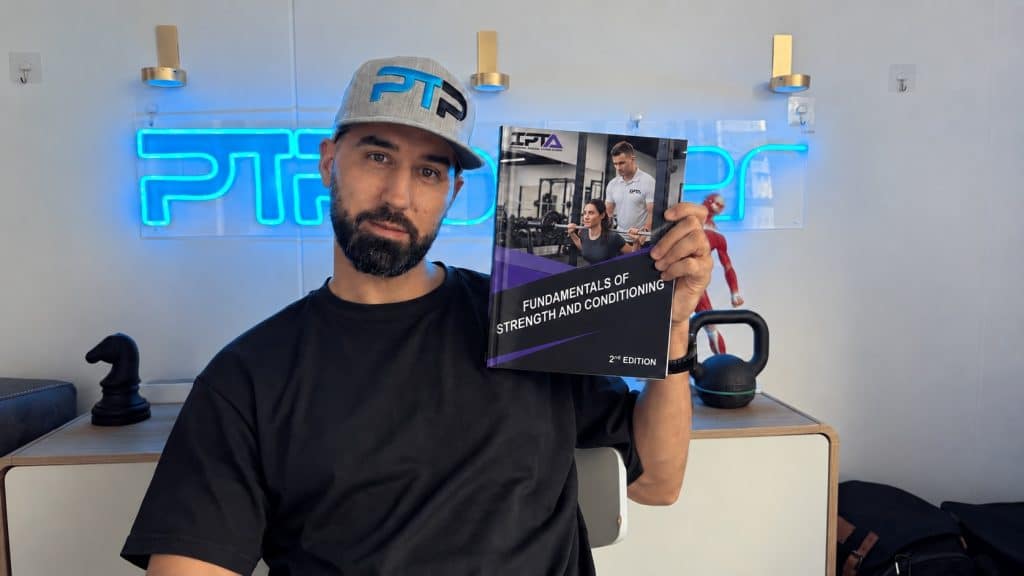
The IPTA Strength and Conditioning Specialist (IPTA SCS) program is the most demanding certification IPTA offers, and it is aimed squarely at the point where general fitness stops being enough. Your client got strong, then got bored, then asked how to get faster. This is the credential that answers that question.
If you are looking for a strength and conditioning certification with real programming depth, and you do not hold the bachelor’s degree that the CSCS requires, this review covers all of the details: program structure, pricing, study materials, pros and cons, and a full walkthrough of the seven domains of study.
I will also cover what you get and what you can expect to gain from the International Personal Trainer Academy premium study material packages.
If you are still deciding on which certification to pick, I suggest you take this quiz.
| Organization | International Personal Trainer Academy |
| Program Type | Advanced Strength and Conditioning Certification |
| Certification Awarded | SCS (Strength and Conditioning Specialist) |
| Format | 100% online, self-paced |
| Study Materials | 726-page textbook, 25 chapters, chapter quizzes, practice exam, final exam |
| Exam | 100 multiple choice questions, 70% to pass, unlimited retakes |
| Difficulty Level | Advanced |
| Time to Complete | 4 to 6 months part-time |
| Prerequisites | None, no degree required |
| Certification Valid | 4 years, with recertification at the two-year mark |
| Cost | $399 to $799, or $49 today with the balance over eleven months |
What is the IPTA SCS?
This strength and conditioning specialization comes from the International Personal Trainer Academy, the same organization behind the NCCA accredited IPTA CPT certification.
The SCS covers maximal strength, power and speed, and the job of taking a client from general fitness to measurable athletic performance. It is a structured, self-paced online program built on a 726-page textbook across 25 chapters, which makes it the longest book in IPTA’s catalog.
The program sits inside IPTA’s PRIME method, specifically the Maximize and Explode phases. Where the corrective certification is the deep dive on movement readiness, the SCS is the deep dive on producing force and producing it fast. The framework organizes the book, but it is not exam content, which is worth knowing before you spend study time memorizing it.
What sets this apart from most online strength certifications is that it does not stop at programming templates. There is a full chapter on Olympic weightlifting and explosive lifting technique, another on velocity-based training and monitoring technology, and another on anti-doping frameworks. That is closer to a university strength and conditioning syllabus than to a weekend specialization.
Who Should Take the SCS Program?
This program is ideal for:
- Trainers whose clients have outgrown general fitness and want measurable performance.
- Coaches working with high school, club or recreational athletes.
- Trainers who handle teams or squads and need to program for a group of athletes at once.
- Former athletes moving into coaching who want the science behind what they did instinctively.
- Anyone who wants CSCS-level content without a bachelor’s degree.
That last point matters more than any other. The NSCA CSCS requires a bachelor’s degree to sit the exam. The IPTA SCS does not, and it covers much of the same ground.
Is the IPTA SCS worth it?
Yes, the IPTA SCS is worth it, and for one group of trainers it is worth it more than any other certification on the market.
If you have a degree and you want to work in collegiate or professional sport, get the CSCS. That is the honest answer and no review should tell you otherwise. But most trainers reading this do not have a kinesiology degree, and the CSCS door is closed to them entirely. For that reader the SCS is not a consolation prize. It is a 726-page education in the same subject, with seven chapters on program design alone, and nothing standing between you and the exam.
IPTA also lets you read the entire SCS textbook for free before you buy, no payment details required, and the purchase carries a no-questions-asked 7-day money back guarantee.
| Great For: | Not Recommended For: |
|---|---|
| Trainers without a degree who want performance work | Anyone targeting a collegiate or pro job |
| Coaches of high school and club athletes | Trainers who only work with general population |
| Trainers programming for teams and squads | Someone wanting a quick, easy specialization |
| Former athletes moving into coaching |
Study Materials Review
The cornerstone of the program is the IPTA SCS Textbook, organized into seven domains across 25 chapters. Each chapter opens with learning objectives and closes with key takeaways and a quiz, and the applied chapters carry substantial technique photography.
Here is a breakdown of the seven domains:
1. Scientific Foundations (Chapters 2 to 4)
Applied exercise science for strength and power, energy system dynamics for conditioning, and the biomechanics of force application and power output.
📖 Example from the text: Chapter 4 establishes the force-velocity relationship, the stretch-shortening cycle and rate of force development at the level of the motor unit, and Chapter 12 later converts that same curve into actual training methods. The book builds rather than repeats.
Exclusive PTP CPT Offers |
||
|---|---|---|
Best Overall Cert | Best Online Cert | Best Study Materials |
Gold Standard Cert | A Good Option | Best CPT for you?  |
2. Athlete Assessment and Profiling (Chapters 5 and 6)
Principles and administration of athletic assessment, then sport demand analysis, performance testing and athlete profiling.
📖 Example from the text: The profiling chapter is refreshingly clear-eyed about movement screens, teaching that the FMS and Y-Balance Test are reasonable entry points for risk identification as long as you are honest about what they can and cannot tell you.
3. Exercise Technique and Session Delivery (Chapters 7 to 9)
Strength training technique and coaching, Olympic weightlifting and explosive lifting technique, and session design including warm-up architecture and movement preparation.
📖 Example from the text: Olympic lifting gets an entire dedicated chapter rather than a few pages, covering the derivatives and progressions that let you coach the lifts to an athlete who will never compete in weightlifting.
4. Program Design and Periodization (Chapters 10 to 16)
The largest domain by a wide margin, at seven chapters: maximal strength programming, accessory work and structural balance, power and rate of force development, speed and change of direction, metabolic conditioning, periodization, and sport-specific program design.
📖 Example from the text: Weak-point analysis and structural balance get their own chapter, which is the kind of content usually left to coaching folklore rather than written down and taught systematically.
5. Nutrition, Recovery, and Monitoring (Chapters 17 to 20)
Technology and data-driven coaching, nutrition for strength and power athletes, ergogenic aids and anti-doping, and recovery, regeneration and load management.
📖 Example from the text: Chapter 17 teaches velocity-based training properly, including individual load-velocity profiling and velocity-loss cutoffs that end a set when bar speed decays. Chapter 19 covers WADA, USADA and the principle of strict liability, so you understand exactly where a coach’s responsibility sits.
6. Athlete Care and Special Populations (Chapters 22 to 24)
Injury risk reduction and return to performance, developmental considerations for youth athletes and the aging competitor, and environmental challenges.
📖 Example from the text: The youth chapter teaches peak height velocity as the reference point for maturity-based programming, making the case that chronological age tells you very little about how to load a fourteen-year-old. The return-to-performance chapter uses the Bern consensus staged model.
7. Professional Practice and Leadership (Chapters 1, 21 and 25)
Scope of practice and role differentiation, performance psychology and coaching leadership, and facility design, safety systems and professional development.
📖 Example from the text: The facility chapter covers emergency action planning, which is the sort of content that feels dull until the day you need it and nobody in the weight room knows who is calling 911.
IPTA SCS Exam Prep and Study Materials
IPTA spent years refining study programs for other organizations’ certifications, including the CSCS, before launching their own. The SCS gets the full treatment, and given the size of this book you will use all of it:

- SurePass AI: Assesses your readiness for the exam so you can spend your study time on the material you have not locked in yet.
- Exam simulator, 800+ practice questions: A full-length bank separate from the final exam and weighted to the same domain blueprint.
- 750 flashcards with spaced repetition: Thirty per chapter across all 25 chapters, built around definitions, protocols, thresholds and scope boundaries.
- 375 short-answer study guide: Fifteen per chapter, for the recall that multiple choice lets you fake.
- Mnemonics set: Five memory hooks for every chapter, 125 in total, aimed at the periodization models and energy system parameters.
- Cheat sheet: A single-page, 58-term reference covering the whole book.
- Audio study guides and interactive reader: For the commute and for note-taking respectively.
- Weak point training with performance reporting: Identifies your weakest domains before test day.
The Exam
The SCS concludes with a comprehensive final exam covering all seven domains, which unlocks after you finish the study modules and quizzes.
- Format: Online, 100 four-option multiple choice questions
- Passing Score: 70%
- Difficulty: High, the hardest of IPTA’s specializations
- Retakes: Unlimited, with no re-sit fee
The blueprint is weighted, and at 100 questions the weighting reads directly as question counts:
| Domain | Chapters | Weight | Questions |
|---|---|---|---|
| I. Scientific Foundations | 2 to 4 | 15% | 15 |
| II. Athlete Assessment and Profiling | 5 and 6 | 10% | 10 |
| III. Exercise Technique and Session Delivery | 7 to 9 | 18% | 18 |
| IV. Program Design and Periodization | 10 to 16 | 28% | 28 |
| V. Nutrition, Recovery, and Monitoring | 17 to 20 | 14% | 14 |
| VI. Athlete Care and Special Populations | 22 to 24 | 9% | 9 |
| VII. Professional Practice and Leadership | 1, 21, 25 | 6% | 6 |
Domains III and IV together are 46% of the paper, which is the right emphasis. Technique and programming are what a strength coach actually does, and the blueprint reflects that rather than spreading questions evenly across chapters that matter less.
Note that Domain VII is the one block that does not run in chapter order. It gathers chapter 1, chapter 21 and chapter 25, so if you are studying by domain rather than front to back, that is the one to watch for.
The PRIME framework itself is not exam content. You will not be asked to name its phases. Everything the framework organizes is fully testable.
The unlimited retake policy is worth a mention on its own, and it matters more here than on the easier specializations. Most organizations charge somewhere around $200 to sit an exam again. The NSCA charges considerably more than that for a CSCS retake. IPTA charges nothing.
Pricing
The SCS runs $399 to $799 depending on the package, and the top tier is the one to look at.
At $799 you get the SCS and the NCCA accredited IPTA CPT together. Two certifications for one price, and that price sits below what several organizations charge for a single credential.
You can also start at $49 today and spread the balance over eleven months at $89 a month. Pay in full if you can, though. IPTA is upfront that the one-time payment saves you $229, which is the real difference between $1,028 spread out and $799 paid once. The plan is still useful if it is the difference between starting now and not starting, and there is no credit check.
The $799 MVP package carries the extras, and the lower tiers do not include them:
- Unlimited exam retakes with no re-sit fee
- Your first recertification free, plus a free continuing education course from a catalog of 100 or more
- CPR/AED certification, online, with a two-year card
- A professional trainer website, described as a $499 value
- Eight business courses covering training, nutrition and client acquisition
- Access to the Meso coaching app
- The Job Assurance Guarantee
That last one is tied to the CPT rather than the SCS: complete the CPT program, pass the exam, apply to three relevant employers within six months, and if you have no offer, IPTA refunds the course fee. MVP purchasers only, so read the terms.
IPTA also runs a bundle builder. Every bundle starts with the NCCA accredited CPT, and you add from the nutrition, corrective exercise, bodybuilding, group exercise and strength catalog:
| Bundle | Certifications | One-time | Payment plan | Per cert |
|---|---|---|---|---|
| Essential Trainer | CPT + 1 | $799save $229 | $49 then $89/mo | $400 |
| Elite TrainerBest value | CPT + 3 | $999save $249 | $49 then $109/mo | $250 |
| Master Trainer | All 6 | $1,199save $269 | $49 then $129/mo | $200 |
For this certification in particular, the Elite tier deserves a look. Strength coaches end up needing nutrition knowledge almost immediately, and the corrective credential pairs naturally with the injury risk reduction content in chapter 22. Two hundred dollars more than the single-certification price for two additional credentials is the best arithmetic on the page.
Every bundle carries the same study system: full digital textbooks, the exam simulator, flashcards, audio study guides, SurePass readiness scoring, and the exam pass guarantee.
Difficulty
On a scale of 1 to 10, with 10 being the hardest strength and conditioning certification:
- SCS Difficulty: 7/10
This is the hardest thing IPTA sells. The book is 726 pages, the science chapters expect you to work with force-velocity relationships and energy system parameters rather than recognize them, and Domain IV asks you to hold seven chapters of programming detail at once.
It is still meaningfully easier than the CSCS, which is widely considered the toughest exam in the field and which fails a large share of candidates. But do not mistake the absence of a degree requirement for an easy course. Budget four to six months and expect the periodization chapters to need a second pass.
IPTA SCS vs the NSCA CSCS
This is the comparison that matters, so here is the straight version.
The CSCS is the benchmark, and it should be. It is NCCA accredited, it is decades old, and it is the credential collegiate and professional programs ask for by name. If your goal is a job in that world, the CSCS is not optional and the SCS will not substitute for it.
But the CSCS requires a bachelor’s degree to sit the exam. For a large number of working trainers that single requirement ends the conversation. The IPTA SCS has no degree requirement, and the curriculum is not a watered-down version of the material. Twenty-five chapters covering assessment, Olympic lifting technique, seven chapters of programming, velocity-based training, anti-doping and return to performance is a serious body of knowledge by any standard.
On price the gap is large. The CSCS exam alone costs several hundred dollars before you have bought a single study resource, and the NSCA’s retake fee is among the steepest in the industry. The IPTA SCS package is $799 with the CPT included and unlimited free retakes.
My recommendation splits cleanly. Have a degree and want collegiate or pro work? CSCS. Training athletes in a private, commercial or high school setting, or working without a degree? The SCS gets you the knowledge and a credential, and it does it for less.
Continuing Education Value
The IPTA SCS works as continuing education as well as a standalone credential. Whether you hold the IPTA CPT or your primary certification is with another organization, this course covers the credits you need to recertify, minus the CPR/AED requirement, and the MVP package includes CPR/AED anyway.
The certification is valid for four years, with recertification at the two-year mark. On the MVP package that first recertification is free, and you choose any course from the 100-plus specialty catalog to satisfy it.
| Pros | Cons |
|---|---|
| No degree requirement | Hardest of IPTA’s specializations |
| Genuine programming depth, seven chapters | Not the CSCS, which some jobs require |
| Olympic lifting technique chapter | No hands-on lifting assessment |
| Velocity-based training and monitoring | |
| The CPT is free at the top tier |
Final Verdict
The IPTA SCS is the most serious strength and conditioning certification available to trainers without a bachelor’s degree, and it is not close.
By covering assessment, technique, seven chapters of programming, monitoring technology, anti-doping and athlete care across 726 pages, the program produces coaches who can take a client from general fitness to measurable performance and explain every decision along the way.
If you have the degree and want to work in collegiate or professional sport, get the CSCS. For everyone else training athletes, the SCS delivers the education that credential is built on, without the gate, and at $799 with a CPT included it is the best value in this category.
Rating: 4.5/5 – Highly Recommended
IPTA SCS Frequently Asked Questions (FAQs)
What is the IPTA SCS?
The IPTA SCS is the Strength and Conditioning Specialist certification from the International Personal Trainer Academy. It is an online, self-paced specialization built on a 726-page, 25-chapter textbook covering exercise science, athlete assessment, lifting technique, program design, periodization, monitoring, nutrition and athlete care.
Do I need a degree for the IPTA SCS?
No. This is the main practical difference between the SCS and the NSCA CSCS, which requires a bachelor’s degree to sit the exam. The SCS has no degree requirement and no prerequisite certification.
Is the IPTA SCS as good as the CSCS?
For collegiate and professional jobs, no, and nothing else substitutes for the CSCS in that world. For the knowledge itself, the SCS covers much of the same ground across 25 chapters, and for trainers working in private, commercial or high school settings it is a strong credential at a fraction of the cost.
How many questions is the IPTA SCS exam?
The final exam is 100 multiple choice questions and you need 70% to pass. It is weighted by domain, with 28 questions from program design and periodization, 18 from exercise technique, 15 from scientific foundations, 14 from nutrition and recovery, 10 from assessment, 9 from athlete care and 6 from professional practice. Retakes are unlimited and free.
How much does the IPTA SCS cost?
Packages run from $399 to $799. At $799 you get the SCS and the NCCA accredited IPTA CPT together, plus unlimited exam retakes, a free first recertification, CPR/AED certification and the Job Assurance Guarantee. Through the bundle builder, $999 buys the CPT plus three certifications and $1,199 buys all six.
How long does the IPTA SCS take?
Budget four to six months part-time. It is the longest and hardest of IPTA’s specializations, and the programming chapters reward a second pass.
References
- International Personal Trainer Academy: Strength and Conditioning Specialist Certification. https://traineracademy.org/strength
- IPTA Strength and Conditioning Specialist Textbook, PRIME edition, 25 chapters.
- IPTA Bundle Builder. https://traineracademy.org/bundle-builder
- NSCA: Certified Strength and Conditioning Specialist (CSCS). https://www.nsca.com/certification/cscs/
- NSCA: CSCS Exam Eligibility Requirements. https://www.nsca.com/certification/cscs/



Tyler Read
PTPioneer Editorial Integrity
All content published on PTPioneer is checked and reviewed extensively by our staff of experienced personal trainers, nutrition coaches, and other Fitness Experts. This is to make sure that the content you are reading is fact-checked for accuracy, contains up-to-date information, and is relevant. We only add trustworthy citations that you can find at the bottom of each article. You can read more about our editorial integrity here.