

 Have a question?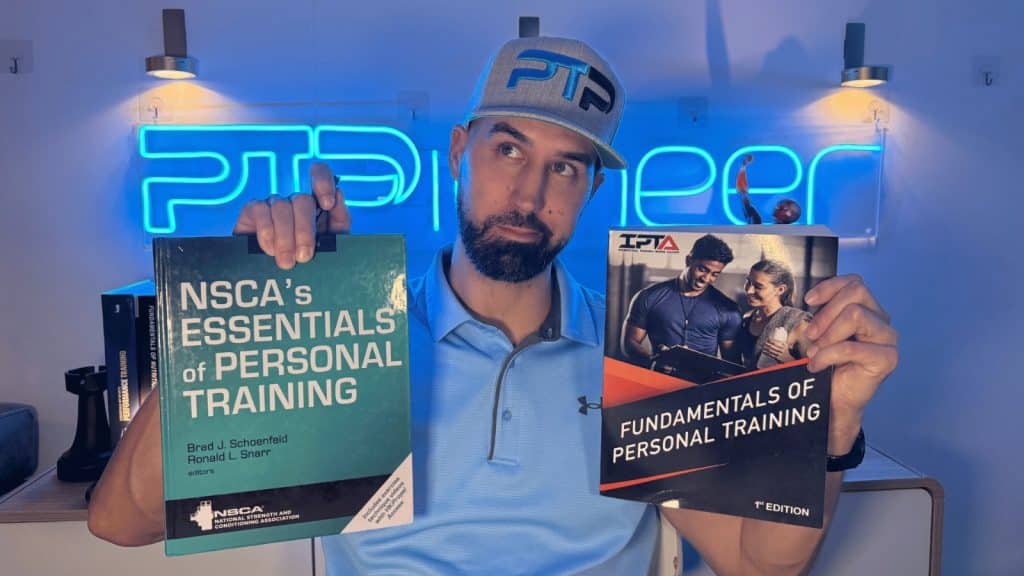
I took both IPTA and NSCA CPT courses to find out which one stands out as the best CPT. The newer IPTA certification comes out on top as the best option for most new trainers. IPTA offers more for less: more professional resources, more study materials, and more value. NSCA remains a great option, but not the best. Read the full review below to see why I picked IPTA over NSCA.
A Quick Comparison: IPTA vs NSCA
| CPT | Features | Price |
|---|---|---|

|
|
View on IPTA Website |
|
|
View on NSCA Website |
Cut your Personal Trainer Certification study time in half with premium study materials for the programs in this article.
Use the code SUMMER799 to receive between 35% and 50% (depending on the program) off the Trainer Academy MVP Study System. Get the trial for any of their study systems here and check out my review for Trainer Academy here.
For more tips on which CPT is best for you, please take the quiz to determine which PT certification is the right fit.
By the end of this article, you’ll have a clear understanding of which certification fits your goals best.
What is the IPTA CPT Certification?
The IPTA CPT is offered through the International Personal Trainer Academy. This CPT program was designed with modern learners in mind. IPTA integrates study aids like flashcards, mnemonics, online tools and emphasizes ease of passing and accessibility.
The IPTA boasts NCCA accreditation and positions itself as one of the more affordable options for a personal trainer certification.
Typical prerequisites include being at least 18 years old, having a high school diploma (or equivalent) and current CPR/AED certification.
The exam covers 6 domains across 135 questions with a 180-minute time limit, and you need 72% to pass.
In short: IPTA is appealing for those who want a streamlined, modern, accessible certification to get into personal training quickly and with fewer financial barriers.
A key strength of IPTA is its affordability. Study packages start at $399 for the Rookie package, which includes the exam, a free textbook and core study tools. The $799 MVP package adds free recertification, free CPR/AED certification and the rest of the study system, and it currently includes a second certification of your choice through a buy one get one free offer. In a very competitive industry, having both training and nutrition (or group fitness) at your disposal gives you a clear advantage over the competition.
I recommend looking at the IPTA Bundle Builder, where you can customize which certifications you want and also save quite a bit of money.
Exclusive PTP CPT Offers |
||
|---|---|---|
Best Overall Cert | Best Online Cert | Best Study Materials |
Gold Standard Cert | A Good Option | Best CPT for you?  |
What is the NSCA CPT Certification?
The NSCA CPT (certified personal trainer) is offered by the National Strength & Conditioning Association, a recognized name in strength & conditioning, performance training and personal training certification.
It was first developed in 1993 and was the first personal training certification to earn NCCA accreditation.
The credential is described as ideal for trainers who “are deeply committed to fitness, driven to know the ‘why’ behind every exercise, and dedicated to uplifting lives through long-term client relationships.”
Eligibility: at least 18 years old, high school diploma (or equivalent), valid CPR/AED certification.
The NSCA CPT places strong emphasis on evidence-based programming, assessments, exercise technique, safety and client consultation. Reviewers note that the curriculum is rigorous and rooted in science.
As such, the NSCA CPT may appeal to trainers who are serious about elevating their professional credibility and are comfortable with a demanding study path.
IPTA and NSCA Prerequisites
Both certifications share common baseline requirements for candidates to sit for the exam:
- Be at least 18 years old.
- Have a high school diploma or equivalency (GED).
- Maintain a current CPR/AED certification.
IPTA and NSCA Pros and Cons
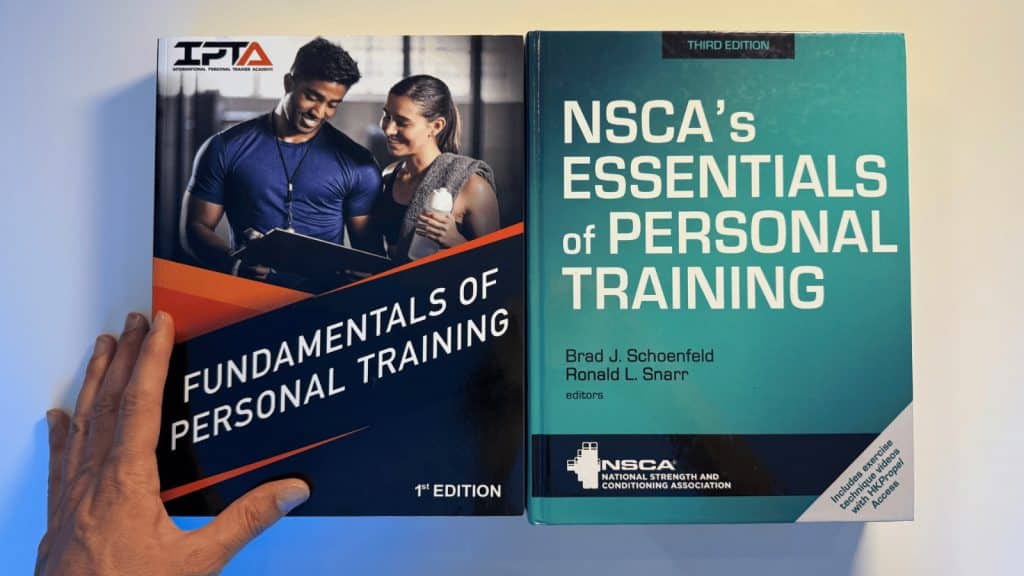
Below we break down how IPTA and NSCA compare across key categories.
Here are the key numbers side by side:
| IPTA CPT | NSCA CPT | |
|---|---|---|
| Entry price | $399 (Rookie): exam, textbook and study tools | $781 non-member: exam $435 plus the CPT Essential Collection, $346. Members: $703 including the $130 Professional membership |
| Fullest package | $799 (MVP) | $1,020 non-member: exam plus the CPT Platinum Collection, $585 |
| Study materials with the exam | Rookie: textbook, interactive study guide, exam simulator, flashcards | None; study collections are sold separately |
| Exam retake | Free and unlimited on MVP; $199 on Rookie | The full exam fee again: $435, or $300 for members |
| Recertification | First renewal free on MVP, then $99 every 2 years; 24 CEUs | $35 to $90 every 3 years; 6.0 CEUs (60 hours) |
| Payment plan | MVP only: $49 down plus 11 payments of $89 ($1,028 total) | None |
| Exam | 135 questions, 180 minutes, 72% to pass | 155 questions (15 unscored), 3 hours, scaled score of 70 to pass |
Cost and Value Comparison
IPTA is positioned as one of the more affordable NCCA-accredited CPT options. The Rookie package starts at $399 and includes the exam, the digital textbook and core study tools. The $799 MVP package adds the full study system, unlimited retakes, a free first recertification, CPR/AED, a job guarantee and, currently, a second certification.
NSCA costs much more than IPTA’s Rookie package. The exam itself costs $435 ($300 for NSCA members), but it includes no study materials, so you’ll also want to buy the textbook and some study materials. NSCA sells two study collections, and neither includes the exam:
- CPT Essential Collection, $346: the Essentials of Personal Training textbook, quizzes, an online practice test and the NSCA PDF study guide. With the exam, that’s $781.
- CPT Platinum Collection, $585: everything in the Essential Collection plus the Exercise Technique Manual. With the exam, that’s $1,020.
Member prices are lower, but only once you’ve paid for membership. Most people buy the Professional membership at $130 a year, which brings the member route with the Essential Collection to $703.
So even NSCA’s cheapest realistic route is almost double IPTA’s Rookie package. Against IPTA’s MVP the prices are close, with the Essential route $18 below it, but the packages aren’t comparable. NSCA’s $781 buys the exam, a textbook, quizzes, one practice test and a study guide, while IPTA’s $799 MVP adds the full study system, unlimited free retakes (an NSCA retake is the full $435 again), a free first recertification, CPR/AED, a trainer website, a business course library, a job guarantee and, currently, a second certification.
Study Materials & Learning Experience
IPTA emphasizes a modern, interactive, tech-driven learning system (flashcards, mnemonics, online tracking). This is helpful for students who want a guided structure.
NSCA uses a more traditional format: a textbook (e.g., Essentials of Personal Training), online modules, interactive learning, but is heavier on exercise science, theory and depth.
IPTA is easier for self‐learners who prefer modern study aids; likely faster to complete. It may not dive as deeply into complex science or advanced populations as older programs like NSCA, but it does cover business content NSCA leaves out.
Exam Structure, Accreditation, and Difficulty
IPTA is NCCA-accredited, which supports industry recognition. You are tested in 6 domains, with 135 questions, which you must complete within 180 minutes, and you need 72% to pass.
NSCA also has NCCA accreditation; the exam is considered rigorous and respected. It has 155 questions, 15 of them unscored, in 3 hours, and you need a scaled score of 70 to pass, which is not the same as 70 percent. You must answer scenario-based questions, with an emphasis on consultation, programming, and technique rather than rote anatomy alone.
Which is harder? If you compare the accredited versions: likely both are substantial, but NSCA may pose a steeper challenge because of its depth and emphasis on evidence-based practice. IPTA may feel more accessible but still credible. IPTA’s MVP package also gives you unlimited free exam retakes, and a Rookie retake is $199. If you fail the NSCA exam, you have to pay the full exam fee again to retake it, and wait at least 30 days from your most recent exam date before scheduling the retake. If you fail 3 times in a row, you must wait one full year from your last test date before registering again.
Accreditation: Both claim NCCA accreditation, which is important for employer recognition.
Direct comparison: Both exams require solid preparation, but there are differences in structure, depth and recognition.
Career Support & Guarantees
IPTA focuses on getting you certified affordably and quickly. On the MVP package you get extras like the Job Assurance Guarantee, and the MVP package currently bundles a second certification, such as nutrition, alongside the CPT. It’s a good entry point with lower financial risk and a faster time to certification.
NSCA offers a strong alumni network, high brand prestige, access to advanced certifications (for those who wish to move beyond general personal training into strength & conditioning, performance coaching, etc.) However, this also means more of an initial investment of time and money; it may be more than a basic personal trainer needs if the goal is general fitness.
Long-Term Career Growth & Specializations
For trainers who plan to build a general personal training business, work in local gyms or online training, and want a cost-effective start, IPTA is a strong fit. IPTA also now offers five specialist certifications alongside the CPT, covering nutrition, strength and conditioning, corrective exercise, group exercise and bodybuilding.
For trainers who want to specialize in sports coaching (athletes, sports teams, research-based programs) and seek top-tier credentialing, NSCA offers a clearer pathway.
In other words: IPTA is well-suited for entry into the industry; NSCA is geared more toward long-term advancement in the strength and conditioning world.
Bottom Line and Recommendation
In the end, both the IPTA CPT and NSCA CPT are legitimate personal trainer certifications—each with distinct strengths.
Here’s a summary of which might suit you best:
- Choose IPTA CPT if you:
- Are newer to the fitness industry and want to enter personal training quickly and affordably.
- Prefer a modern study system with interactive tools and want to minimize time to certification.
- Plan to work general population clients (e.g., commercial gym, online training) and are not immediately seeking highly specialized or elite performance clients.
- Choose NSCA CPT if you:
- Want the strongest brand recognition and plan to rise into higher-level roles (e.g., performance training, athlete conditioning).
If I were to give a final verdict: For most new trainers wanting to “get started,” IPTA offers excellent value with competent accreditation and accessible pathways. But if you know you want to “go big” (athletes, advanced clients, performance niches) then NSCA is likely the wiser investment.
Most people will lean towards the IPTA CPT, but if you want to train athletes, go with NSCA.


Tyler Read
PTPioneer Editorial Integrity
All content published on PTPioneer is checked and reviewed extensively by our staff of experienced personal trainers, nutrition coaches, and other Fitness Experts. This is to make sure that the content you are reading is fact-checked for accuracy, contains up-to-date information, and is relevant. We only add trustworthy citations that you can find at the bottom of each article. You can read more about our editorial integrity here.