

 Have a question?
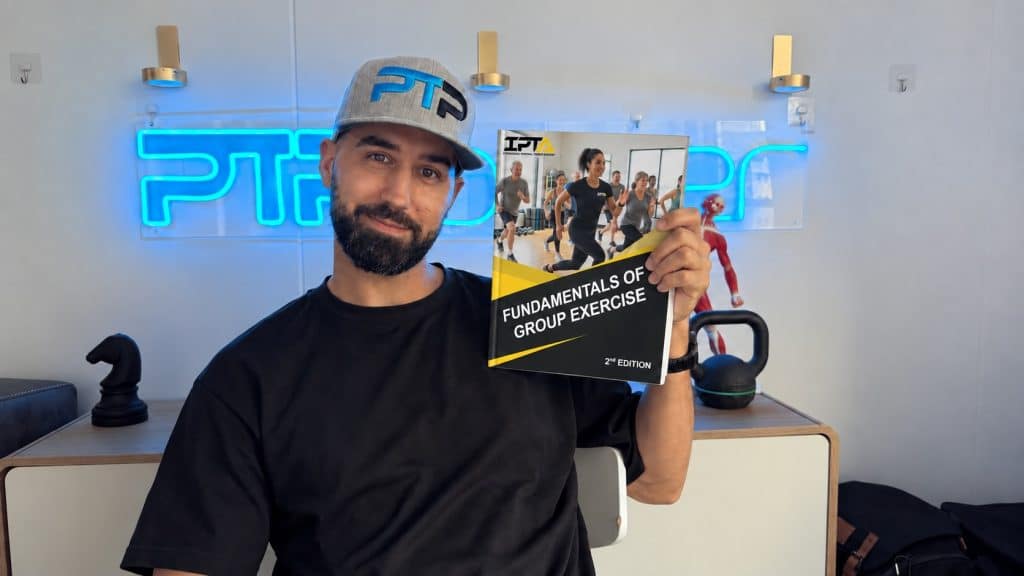
The IPTA Group Exercise Specialist (GES) program is built around a problem every trainer eventually runs into: you can only sell the same hour once. Group changes that math, and this certification is about teaching you to do it well rather than just loudly.
If you are looking for a group fitness credential that treats class design as a skill, covers the science behind cueing and music selection, and takes the business of filling a room seriously, this review covers all of the details: program structure, pricing, study materials, pros and cons, and a full walkthrough of the six domains of study.
I will also cover what you get and what you can expect to gain from the International Personal Trainer Academy premium study material packages.
If you are still deciding on which certification to pick I suggest you take the quiz.
| Organization | International Personal Trainer Academy |
| Program Type | Advanced Group Exercise Certification |
| Certification Awarded | GES (Group Exercise Specialist) |
| Format | 100% online, self-paced |
| Study Materials | 666-page textbook, 24 chapters, 226 figures, chapter quizzes, practice exam, final exam |
| Exam | 100 multiple choice questions, 70% to pass, unlimited retakes |
| Difficulty Level | Moderate |
| Time to Complete | 3 to 6 months part-time |
| Prerequisites | None, the method is taught from the ground up |
| Certification Valid | 4 years, with recertification at the two-year mark |
| Cost | $399 to $799, or $49 today with the balance over eleven months |
What is the IPTA GES?
This group exercise specialization comes from the International Personal Trainer Academy, the same organization behind the NCCA accredited IPTA CPT certification.
The GES is designed for instructors who want to coach a room rather than perform at it. Anyone can lead a class. Delivering a real training effect to twenty people with wildly different fitness levels, in the same hour, without losing the room or hurting anybody, is a different skill entirely. That is what this certification teaches.
It is a structured, self-paced online program built on a 666-page textbook across 24 chapters, and it is heavily illustrated at 226 figures. The curriculum moves from screening and audience analysis, through the exercise science behind class design, into modification and cueing, and finishes with group psychology, retention, and four chapters of format-specific application.
The program is organized around IPTA’s TEACH method: Target your participants, use Evidence-based programming, Adapt in real time, Cue with craft, and Host the room. Every chapter closes by tying its content back to one of those five skills, which keeps a long book coherent.
Who Should Take the IPTA Group Exercise Specialist?
This program is ideal for:
- Trainers who have run out of billable hours and need a way to scale beyond one client at a time.
- Trainers moving into semi-private coaching, where the room is small but the problem is the same.
- Instructors who have been delivering pre-designed formats and want to write their own programming.
- Regular class participants who are already coaching informally and want the credential to match.
If you want to understand why a class works rather than copy one that does, the GES is the credential that teaches it.
Is the IPTA GES worth it?
Yes, the IPTA GES is worth it, and the reason is that it is a real education rather than a choreography handout.
Most group fitness certifications teach you to deliver someone else’s class. This one spends six chapters on the exercise science behind class design alone, covering physiology, biomechanics, music and tempo science, class structure, intensity prescription, and periodization for group formats. That is the largest domain in the book and the largest block on the exam, and it is what separates an instructor who can build a class from one who can only run one.
IPTA also lets you read the entire GES textbook for free before you buy, no payment details required, and the purchase carries a no-questions-asked 7-day money back guarantee. That makes this a genuinely low-risk decision.
| Great For: | Not Recommended For: |
|---|---|
| Trainers who need to scale past one-on-one | Anyone wanting a specific branded format license |
| Instructors who want to write their own programming | Trainers who only ever want to train individuals |
| Semi-private and small-group coaches | Someone who wants an in-person practical course |
| Anyone needing CEUs with actual substance |
Study Materials Review
The cornerstone of the program is the IPTA GES Textbook, organized into six domains across 24 chapters. Each chapter opens with an overview, a “why this matters” section and learning objectives, and closes with a summary, key takeaways and key terms. The callout boxes are worth noting: instructor tips, scope of practice warnings, research spotlights, common mistakes and exam flags run throughout at roughly a dozen per chapter.
Here is a breakdown of the six domains:
1. Foundations, Screening, and Professional Practice (Chapters 1 to 5)
Students start with the role itself, then pre-exercise screening and readiness, understanding your audience, scope of practice and legal risk management, and special populations in group settings.
Exclusive PTP CPT Offers |
||
|---|---|---|
Best Overall Cert | Best Online Cert | Best Study Materials |
Gold Standard Cert | A Good Option | Best CPT for you?  |
📖 Example from the text: The scope chapter puts the legal content alongside the screening content deliberately, so you learn where your authority ends at the same time you learn how to assess who walked into your class.
2. Exercise Science and Class Design (Chapters 6 to 11)
The largest domain and the core of the credential. It covers exercise physiology, functional anatomy and biomechanics for group movement, music programming and tempo science, class structure and design, intensity prescription and heart rate zones, and periodization for group formats.
📖 Example from the text: The music chapter is not filler. It teaches the BPM to intensity relationship and explains dissociation, the effect by which music pulls attention away from internal effort signals and lowers perceived exertion at an unchanged workload. That is a real coaching tool, explained properly.
3. Modification, Safety, and Mixed-Ability Teaching (Chapters 12 to 14)
Exercise modification, injury prevention in group settings, and differentiation at scale, which is the art of running one class that genuinely serves the strongest and weakest people in the room.
📖 Example from the text: The mixed-ability chapter treats differentiation as a planning problem rather than an improvisation problem, giving you regressions and progressions built into the class design before anyone walks in.
4. Cueing and Communication (Chapters 15 to 17)
Verbal, visual and kinesthetic cueing, the motor learning science behind attentional focus, and demonstration, voice and instructor communication.
📖 Example from the text: Chapter 16 cites a 2021 meta-analysis pooling 214 studies showing external focus cues outperform internal focus cues for both immediate performance and longer-term learning, at an effect size around 0.3 to 0.5. The chapter then converts that into the actual words you say to a room.
5. Group Dynamics, Leadership, and Retention (Chapters 18 to 20)
Group cohesion and social identity, transformational leadership and instructor presence, and participant retention, community building and career longevity.
📖 Example from the text: The cohesion chapter draws on the exercise psychology literature on why group-based participation outlasts solo participation, then turns it into practical room management rather than leaving it as theory.
6. Format-Specific Application (Chapters 21 to 24)
Four chapters applying everything to specific formats: high intensity training, cycling and cardio, dance and rhythm-based classes, and mind-body formats including yoga, Pilates, tai chi and qigong.
📖 Example from the text: Each format chapter runs the same five-skill structure, so you can see how targeting, programming, adaptation, cueing and hosting change when you move from a HIIT room to a mind-body room.
IPTA GES Exam Prep and Study Materials
IPTA spent years refining study programs for other organizations’ certifications before launching their own, and their materials are widely regarded as some of the best in the industry. The GES gets the full treatment:

- SurePass AI: Assesses your readiness for the exam so you can spend your study time on the material you have not locked in yet.
- Exam simulator, 800+ practice questions: A full-length bank separate from the final exam and weighted to the same domain blueprint, so a practice run actually predicts your result.
- 720 flashcards with spaced repetition: Thirty per chapter across all 24 chapters, built around definitions, protocols, thresholds and scope boundaries.
- 360 short-answer study guide: Fifteen per chapter, for the recall that multiple choice lets you fake.
- Mnemonics set: Over 100 memory devices for the cueing sequences, screening protocols and heart rate zone models.
- Cheat sheet: A single-page, 64-term reference covering the whole book.
- Audio study guides and interactive reader: For the commute and for note-taking respectively.
- Weak point training with performance reporting: Identifies your weakest domains and recommends what to review before test day.
The Exam
The GES concludes with a comprehensive final exam covering all six domains, which unlocks after you finish the study modules and quizzes.
- Format: Online, 100 four-option multiple choice questions
- Passing Score: 70%
- Difficulty: Moderate
- Retakes: Unlimited, with no re-sit fee
The blueprint is weighted, and because the exam is 100 questions the weighting reads directly as question counts:
| Domain | Chapters | Weight | Questions |
|---|---|---|---|
| I. Foundations, Screening, and Professional Practice | 1 to 5 | 20% | 20 |
| II. Exercise Science and Class Design | 6 to 11 | 27% | 27 |
| III. Modification, Safety, and Mixed-Ability Teaching | 12 to 14 | 12% | 12 |
| IV. Cueing and Communication | 15 to 17 | 15% | 15 |
| V. Group Dynamics, Leadership, and Retention | 18 to 20 | 12% | 12 |
| VI. Format-Specific Application | 21 to 24 | 14% | 14 |
Two things stand out. The domains run in book order, so studying front to back matches the exam exactly, which is more helpful than it sounds. And Domain II alone is more than a quarter of the paper. If you are short on time, chapters 6 through 11 are where the marks are.
One useful note on what is not tested: the TEACH acronym itself is not exam content. You will not be asked what the letters stand for. Everything the framework organizes, from screening through cueing through group dynamics, is fully testable.
The unlimited retake policy deserves a mention on its own. Most organizations charge somewhere around $200 to sit an exam again. IPTA charges nothing, which takes the financial pressure off test day entirely.
Pricing
The GES runs $399 to $799 depending on the package, and the top tier is the interesting one.
At $799 you get the GES and the NCCA accredited IPTA CPT together. Two certifications for one price, and that price sits below what several organizations charge for a single credential. For a group instructor who does not yet hold a CPT, that is close to a no-brainer, since most gyms want the CPT on file regardless of what you teach.
You can also start at $49 today and spread the balance over eleven months at $89 a month. Pay in full if you can, though. IPTA is upfront that the one-time payment saves you $229, which is the real difference between $1,028 spread out and $799 paid once. The plan is still useful if it is the difference between starting now and not starting, and there is no credit check.
The $799 MVP package carries the extras, and the lower tiers do not include them:
- Unlimited exam retakes with no re-sit fee
- Your first recertification free, plus a free continuing education course from a catalog of 100 or more
- CPR/AED certification, online, with a two-year card
- A professional trainer website, described as a $499 value
- Eight business courses covering training, nutrition and client acquisition
- Access to the Meso coaching app
- The Job Assurance Guarantee
That last one is tied to the CPT rather than the GES: complete the CPT program, pass the exam, apply to three relevant employers within six months, and if you have no offer, IPTA refunds the course fee. MVP purchasers only, so read the terms.
IPTA also runs a bundle builder, and this is where the GES gets cheap. Every bundle starts with the NCCA accredited CPT, and you add from the nutrition, strength and conditioning, bodybuilding, corrective exercise and group exercise catalog:
| Bundle | Certifications | One-time | Payment plan | Per cert |
|---|---|---|---|---|
| Essential Trainer | CPT + 1 | $799save $229 | $49 then $89/mo | $400 |
| Elite TrainerBest value | CPT + 3 | $999save $249 | $49 then $109/mo | $250 |
| Master Trainer | All 6 | $1,199save $269 | $49 then $129/mo | $200 |
The arithmetic is worth sitting with. The GES alone at the Essential tier costs $799 and gets you two certifications. Elite costs $200 more and gets you two additional ones. Group instructors tend to end up teaching across formats and populations, so if there is any chance you will want the corrective or nutrition credential within a couple of years, Elite is the obvious buy.
Every bundle carries the same study system: full digital textbooks, the exam simulator, flashcards, audio study guides, SurePass readiness scoring, and the exam pass guarantee.
Difficulty of the IPTA Group Exercise Specialist
On a scale of 1 to 10, with 10 being the hardest group exercise certification:
- GES Difficulty: 5/10
It is more demanding than the entry-level group fitness certifications and less demanding than a specialist corrective or strength credential. The conceptual load sits almost entirely in Domain II, where the physiology, biomechanics and intensity prescription chapters expect you to actually do the heart rate zone arithmetic rather than recognize it. Everything after chapter 11 is more applied and reads faster.
IPTA GES vs Other Group Exercise Certifications
The established names here are the ACE Group Fitness Instructor certification and AFAA, both of which have been the default group credential for years and both of which carry solid employer recognition.
The honest comparison runs like this. ACE and AFAA have the brand. The IPTA GES has the deeper curriculum, and it is not particularly close. Six chapters on exercise science and class design, three on cueing with the motor learning research behind it, and four format-specific application chapters is more ground than the established group certifications cover, and the textbook is roughly twice the length.
On price, IPTA wins clearly, and it hands you an NCCA accredited CPT inside the same $799.
Where the competition still has an edge is recognition at the front desk, and that is a real consideration for a credential whose whole purpose is getting you on a group schedule. If the gym you want to teach at has a list of accepted certifications taped to the wall, check the list first.
What the GES is Not
Worth being clear about this, because it is the most common misunderstanding with any group credential. The GES is a coaching certification, not a format license. It does not authorize you to teach a branded format like Zumba, Les Mills or spin programs that require their own training. Those are separate licenses bought from those companies.
What the GES gives you is the underlying competence: how to build a class, scale it, cue it and keep people coming back. That transfers to any format, branded or otherwise, and it is what a gym is actually assessing when they decide whether to give you a slot.
Continuing Education Value
The IPTA GES works as continuing education as well as a standalone credential. Whether you hold the IPTA CPT or your primary certification is with another organization, this course will cover the credits you need to recertify, minus the CPR/AED requirement, and the MVP package includes CPR/AED anyway.
The certification is valid for four years, with recertification at the two-year mark. On the MVP package that first recertification is free, and you choose any course from the 100-plus specialty catalog to satisfy it. Most organizations charge $200 or more at that point.
| Pros | Cons |
|---|---|
| Genuine class-design and programming depth | Not a branded format license |
| Cueing and motor learning science | No live teaching assessment |
| Four format-specific application chapters | Newer credential |
| Strong retention and career content | |
| The CPT is free at the top tier |
Final Verdict
The IPTA GES is the most thorough group exercise certification I have reviewed, and it is aimed at instructors who want to understand their craft rather than perform someone else’s routine.
By spending its largest domain on the science of class design, treating cueing as a research-backed skill, and finishing with four chapters of format-specific application, the program turns out instructors who can build a class from scratch for any room they walk into.
If you want a group credential with real depth, and you are buying a CPT anyway, the $799 package is the best value in this category. If your only concern is which certification the gym down the road already accepts, check their list before you buy.
Rating: 4.5/5 – Highly Recommended
IPTA GES Frequently Asked Questions (FAQs)
What is the IPTA GES?
The IPTA GES is the Group Exercise Specialist certification from the International Personal Trainer Academy. It is an online, self-paced specialization built on a 666-page, 24-chapter textbook covering screening, class design, modification, cueing, group dynamics and format-specific application.
How many questions is the IPTA GES exam?
The final exam is 100 multiple choice questions and you need 70% to pass. It is weighted by domain, with 27 questions from exercise science and class design, 20 from foundations and screening, 15 from cueing, 14 from format-specific application, and 12 each from modification and group dynamics. Retakes are unlimited and free.
How much does the IPTA GES cost?
Packages run from $399 to $799. At $799 you get the GES and the NCCA accredited IPTA CPT together, plus unlimited exam retakes, a free first recertification, CPR/AED certification and the Job Assurance Guarantee. Through the bundle builder, $999 buys the CPT plus three certifications and $1,199 buys all six. You can start any of them at $49 today with the balance over eleven months.
Do I need a personal training certification first?
No. IPTA states there is no prerequisite and the method is taught from the ground up. If you already hold the IPTA CPT, the GES adds the group dimension to a system you already know. At the $799 tier the CPT is included anyway.
Does the IPTA GES let me teach Zumba or Les Mills?
No, and no general group certification does. Branded formats require their own separate licensing from those companies. The GES teaches the underlying coaching competence that transfers to any format.
Does the IPTA GES count toward recertification?
Yes. It satisfies the continuing education credits for a standard recertification cycle, whether your primary certification is with IPTA or another organization. The certification is valid for four years with recertification at the two-year mark, and on the MVP package that first recertification is free.
References
- International Personal Trainer Academy: Group Exercise Specialist Certification. https://traineracademy.org/group
- IPTA Group Exercise Specialist Textbook, Reader Edition, 24 chapters.
- IPTA Bundle Builder. https://traineracademy.org/bundle-builder
- ACE: Group Fitness Instructor Certification. https://www.acefitness.org
- AFAA: Group Fitness Instructor. https://www.afaa.com



Tyler Read
PTPioneer Editorial Integrity
All content published on PTPioneer is checked and reviewed extensively by our staff of experienced personal trainers, nutrition coaches, and other Fitness Experts. This is to make sure that the content you are reading is fact-checked for accuracy, contains up-to-date information, and is relevant. We only add trustworthy citations that you can find at the bottom of each article. You can read more about our editorial integrity here.