

 Have a question?
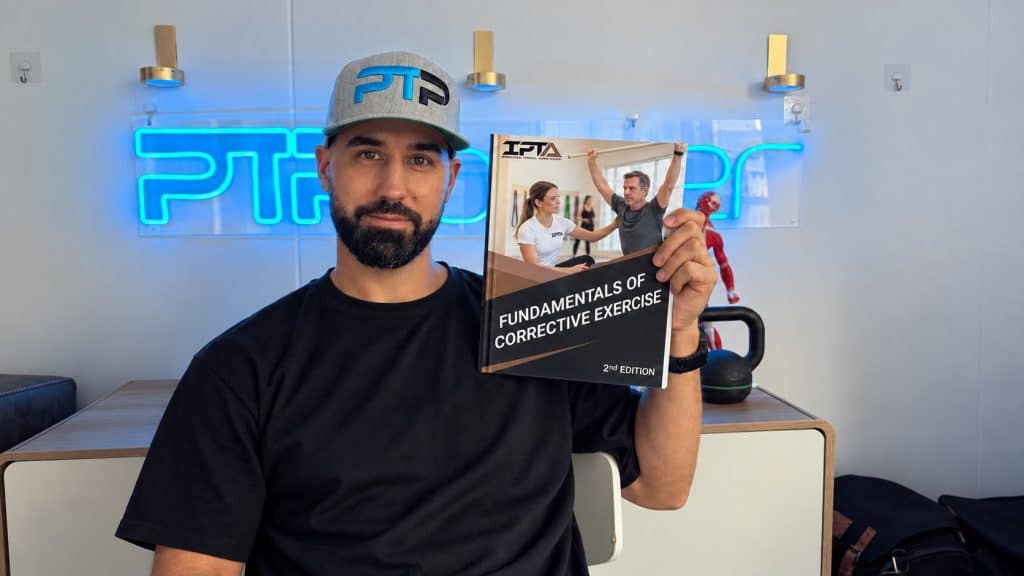
The IPTA Corrective Exercise Specialist (CES) program is one of the most thorough corrective exercise certifications available right now. It is built around movement assessment and the correction of dysfunction, and it treats both as a coaching skill rather than a clinical one.
If you are looking for a corrective credential that teaches you how to screen a client, read what the screen is telling you, and build a program that actually fixes the problem, this review covers all of the details: program structure, pricing, study materials, pros and cons, and a full walkthrough of the five domains of study.
I will also cover what you will get and what you can expect to gain from the International Personal Trainer Academy premium study material packages.
If you are still deciding on which certification to pick I suggest you take the quiz.
| Organization | International Personal Trainer Academy |
| Program Type | Advanced Corrective Exercise Certification |
| Certification Awarded | CES (Corrective Exercise Specialist) |
| Format | 100% online, self-paced |
| Study Materials | 667-page textbook, 16 chapters, chapter quizzes, practice exam, final exam |
| Exam | 100 multiple choice questions, 70% to pass, unlimited retakes |
| Difficulty Level | Moderate to Advanced |
| Time to Complete | 3 to 6 months part-time |
| Prerequisites | None, the method is taught from the ground up |
| Certification Valid | 4 years, with recertification at the two-year mark |
| Cost | $399 to $799, or $49 today with the balance over eleven months |
What is the IPTA CES?
This corrective specialization comes from the International Personal Trainer Academy, the same organization behind the NCCA accredited IPTA CPT certification.
The IPTA CES is designed for trainers who keep running into the same wall: a client who cannot squat without the knees caving in, a desk worker whose shoulders will not let them press overhead, a runner whose hip drops on every stride. A general CPT teaches you to notice those things. This certification teaches you what to do about them.
It is a structured, self-paced online program built on a 667-page textbook across 16 chapters. The curriculum moves in order from anatomy and motor control, through assessment, into the corrective work itself, and finishes with program design, coaching, ethics, and the business side of offering corrective services.
Unlike many corrective courses that hand you a list of stretches, the CES teaches a repeatable four-step sequence: release, mobilize, strengthen, function. Every corrective strategy in the book routes through that sequence, which means you leave with a method rather than a collection of exercises.
The Four-Step Corrective Sequence
IPTA teaches corrective exercise as a four-step sequence worked in order: Release, Mobilize, Strengthen, Function. Each step has its own tools.
- Release: foam rollers, massage balls and percussion.
- Mobilize: static, dynamic and PNF stretching, banded joint mobilizations and controlled articular rotations (CARs).
- Strengthen: isolated strengthening with bands, light loads, bodyweight and slow eccentrics.
- Function: compound, unilateral, multi-planar and reactive exercises with progressive load.
One line from the book sums it up: “Release and mobilize create the room. Strengthen and function fill it.”
The sequence comes with a safety rule I appreciate. Step 2 is not universal. If a joint is hypermobile, you stabilize it instead of stretching it.
Who Should Take the CES Program?
This program is ideal for:
- Personal trainers whose clients keep presenting with movement restrictions and old injuries.
- Strength coaches who need a systematic way to clear athletes before loading them.
- Group fitness instructors who want to scale and regress movements intelligently.
- Trainers who want to work with the post-rehab population and need to know exactly where their scope ends.
If you want the assessment skills that separate a trainer from an exercise picker, the CES is the credential that builds them.
Is the IPTA CES Worth it?
Yes, the IPTA CES is worth it, and the assessment content is the reason.
Most corrective certifications spend the bulk of their pages on exercises. This one spends three full chapters on assessment alone, covering client intake and movement history, postural assessment and movement screening, and flexibility and joint mobility testing, before it teaches a single corrective technique. That ordering is the whole point. Correcting the wrong thing is worse than correcting nothing.
IPTA also lets you read the entire CES textbook for free before you buy, no payment details required, and the purchase carries a no-questions-asked 7-day money back guarantee. That makes this a genuinely low-risk decision.
Exclusive PTP CPT Offers |
||
|---|---|---|
Best Overall Cert | Best Online Cert | Best Study Materials |
Gold Standard Cert | A Good Option | Best CPT for you?  |
I also highly recommend taking advantage of the BOGO offer which gives you the IPTA CES with the NCCA-accredited CPT for only $799.
| Great For: | Not Recommended For: |
|---|---|
| Trainers who want real assessment skills | Anyone looking for a quick weekend certificate |
| Coaches working with post-rehab clients | Trainers who want a purely exercise-focused course |
| Trainers building a premium, assessment-led service | Someone with no training certification yet |
| Anyone needing CEUs with actual substance |
Study Materials Review
The cornerstone of the program is the IPTA CES Textbook, organized into five domains of study across 16 chapters. Each chapter opens with learning objectives, runs heavy on diagrams and photography, and closes with key takeaways and a quiz.
Here is a breakdown of the five domains:
1. Foundations (Chapters 1 to 4)
Students start with the groundwork: the role of corrective exercise in fitness, functional anatomy and kinetic chains, neuromuscular physiology and motor control, and biomechanics. This domain builds the vocabulary for everything that follows and establishes why a restriction at one joint shows up as a compensation somewhere else.
📖 Example from the text: Chapter 1 includes a within-scope versus outside-scope reference table, so the boundary between corrective exercise and medical treatment is established on page one rather than left to inference.
2. Movement Assessment (Chapters 5 to 7)
The heaviest domain, and the one that earns the credential. Students learn the intake interview and movement history, static postural assessment, dynamic movement screening, gait observation, and goniometric and functional flexibility testing.
📖 Example from the text: The pelvic alignment section teaches you to read neutral, anterior tilt, and posterior tilt from the ASIS to PSIS relationship, then maps the muscular picture that produces each one.
3. Corrective Strategies and Techniques (Chapters 8 to 10)
This is where the four-step sequence gets applied. The domain covers stretching and flexibility enhancement, muscle strengthening and movement re-training, and recovery and regeneration methods, with a large photographic library of demonstrations.
📖 Example from the text: The stretching chapter gives actual dosing rather than vague advice, citing roughly four minutes of total stretch per muscle per session and about ten minutes per week as the point where flexibility gains plateau.
4. Program Design and Coaching (Chapters 11 to 14)
Students move from technique to programming: building and progressing a corrective program, coaching and communication strategies, addressing common pain and injury conditions, and a full chapter of applied case studies.
📖 Example from the text: The case-study chapter walks complete client scenarios end to end, from intake through screen, corrective plan, and reassessment, which is the closest thing to supervised practice a self-study course can offer.
5. Professional and Ethical Practice (Chapters 15 and 16)
The final domain covers ethics, scope of practice, documentation, liability, and the business of marketing corrective services.
📖 Example from the text: The intake chapter is blunt about the line, stating that collecting a health history is within scope while interpreting it medically is not, and that clinical judgement gets passed to the appropriate professional.
IPTA CES Exam Prep and Study Materials
IPTA spent years refining study programs for other organizations’ certifications before launching their own, and their materials are widely regarded as some of the best in the industry. The CES gets the full treatment. Here is what puts these materials ahead:

- SurePass AI: Assesses your readiness for the exam so you can spend your study time on the material you have not locked in yet.
- Exam simulator, 800+ practice questions: A full-length bank separate from the final exam and weighted to the same domain blueprint, so a practice run actually predicts your result.
- 480 flashcards with spaced repetition: Thirty cards per chapter, built around definitions, thresholds, red flags, and scope boundaries, which is what the exam actually tests.
- 240 short-answer study guide: Fifteen per chapter, for the recall that multiple choice lets you fake.
- Interactive study guide: Note-taking and highlighting built in.
- Cheat sheet and mnemonics: A single-page, 48-term reference plus a mnemonic set for the assessment sequences and muscle groupings.
- Weak point training with performance reporting: Identifies your weakest domains and recommends what to review before test day.
The Exam
The CES concludes with a comprehensive final exam covering all five domains, which unlocks after you finish the study modules and quizzes. The format will be familiar to anyone who has taken the IPTA CNS.
- Format: Online, 100 four-option multiple choice questions
- Passing Score: 70%
- Difficulty: Moderate to high, particularly the assessment domains
- Retakes: Unlimited, with no re-sit fee
The blueprint is weighted rather than even, and because the exam is exactly 100 questions the weighting translates directly into question counts:
| Domain | Chapters | Weight | Questions |
|---|---|---|---|
| I. Foundations | 1 to 4 | 20% | 20 |
| II. Movement Assessment | 5 to 7 | 25% | 25 |
| III. Corrective Strategies and Techniques | 8 to 10 | 25% | 25 |
| IV. Program Design and Coaching | 11 to 14 | 20% | 20 |
| V. Professional and Ethical Practice | 15 and 16 | 10% | 10 |
Half the exam sits in assessment and corrective technique, and you need 70 correct to pass. That means the twenty questions in Domain I and the ten in Domain V are not where this exam is won or lost. Chapters 5 through 10 are.
The unlimited retake policy deserves a mention on its own. Most organizations charge somewhere around $200 to sit an exam again, and a few charge considerably more. IPTA charges nothing, which takes the financial pressure off test day entirely. Most students report the exam is manageable anyway if they work the chapter quizzes and sit the practice exam before attempting the final.
Pricing
The CES runs $399 to $799 depending on the package, and the top tier is where this gets interesting.
At $799 you get the CES and the NCCA accredited IPTA CPT together. Two certifications for one price, and that price is below what several organizations charge for a single certification. If you are buying a corrective specialization anyway, picking up an accredited CPT alongside it for nothing is difficult to argue with.
You can also start at $49 today and spread the balance over eleven months at $89 a month. Pay in full if you can, though. IPTA is upfront that the one-time payment saves you $229, which is the real difference between $1,028 spread out and $799 paid once. The plan is still useful if it is the difference between starting now and not starting, and there is no credit check.
The $799 MVP package is the one carrying the extras, and it is worth being specific about what those are, because the lower tiers do not include them:
- Unlimited exam retakes with no re-sit fee
- Your first recertification free, plus a free continuing education course from a catalog of 100 or more
- CPR/AED certification, online, with a two-year card
- A professional trainer website, described as a $499 value
- Eight business courses covering training, nutrition and client acquisition
- Access to the Meso coaching app
- The Job Assurance Guarantee
That last one is worth reading the terms on. It is tied to the CPT rather than the CES: complete the CPT program, pass the exam, apply to three relevant employers within six months, and if you have no offer, IPTA refunds the course fee. MVP purchasers only.
IPTA also runs a bundle builder, and this is where the CES gets genuinely cheap. Every bundle starts with the NCCA accredited CPT, and you add from the nutrition, strength and conditioning, bodybuilding, group exercise and corrective catalog. The per-certification price falls hard as you add:
| Bundle | Certifications | One-time | Payment plan | Per cert |
|---|---|---|---|---|
| Essential Trainer | CPT + 1 | $799save $229 | $49 then $89/mo | $400 |
| Elite TrainerBest value | CPT + 3 | $999save $249 | $49 then $109/mo | $250 |
| Master Trainer | All 6 | $1,199save $269 | $49 then $129/mo | $200 |
The arithmetic is worth sitting with. Taking the CES alone at the Essential tier costs $799 and gets you two certifications. Stepping up to Elite costs $200 more and gets you two additional certifications. If there is any chance you will want the nutrition or strength and conditioning credential within the next few years, the Elite tier is the obvious buy, and Master Trainer puts all six certifications in your hands for $1,199, which is less than a single certification costs at several of the big organizations.
Every bundle carries the same study system: full digital textbooks, the exam simulator, flashcards, audio study guides, SurePass readiness scoring, and the exam pass guarantee.
Set against the alternative, where trainers routinely spend several hundred dollars on a weekend corrective workshop that produces no credential at all, the CES returns both the education and a certification for a single price.
Difficulty
On a scale of 1 to 10, with 10 being the hardest corrective exercise certification:
- CES Difficulty: 6/10
It sits a notch above the nutrition and general specializations. The difficulty is not conceptual so much as volumetric. Domain II alone asks you to hold a large number of specific screens, positions, and compensation patterns in your head, and the exam tests them precisely. Trainers coming from a kinesiology background will move faster. Everyone else should budget real time for chapters 5 through 7.
IPTA CES vs Other Corrective Exercise Certifications
The main competitor is the NASM CES, which has been the default corrective credential for years and carries strong name recognition with employers. ACE and ISSA both offer corrective specializations as well.
The NASM CES is the one most readers will be weighing this against. NASM’s advantage is brand recognition. The IPTA CES’s advantage is depth of assessment content and a clearer corrective sequence. NASM runs its corrective work through its own branded framework; IPTA runs its through release, mobilize, strengthen, function, which I find easier to actually apply on a gym floor without a chart.
On price it is not close. The NASM CES runs well north of the IPTA CES on its own, and IPTA hands you an NCCA accredited CPT in the same $799. The study material package is not close either. No other corrective specialization I have reviewed ships with an 800-question simulator and a 480-card deck.
If employer recognition is your single deciding factor, NASM still wins on name. If what you want is to walk into a session and actually know what to do with a client whose hip drops, the IPTA CES teaches it better.
Continuing Education Value
The IPTA CES is not only a strong standalone certification, it also works as continuing education. Whether you hold the IPTA CPT or your primary certification is with another organization, this course will cover the credits you need to recertify, minus the CPR/AED requirement, and the MVP package includes CPR/AED anyway.
The certification itself is valid for four years, with recertification at the two-year mark. On the MVP package that first recertification is free, and you choose any course from the 100-plus specialty catalog to satisfy it. Most organizations charge $200 or more at that point, so this is a real saving rather than a marketing line.
If you have any interest in assessment and corrective work, this is an efficient way to handle a recertification cycle and come out with a real skill set rather than a completion certificate.
| Pros | Cons |
|---|---|
| Genuinely deep assessment training | Assessment-heavy and detail-dense |
| Teaches a repeatable corrective method | Self-study format |
| Strong scope-of-practice guidance | |
| Case-study chapter ties it all together | |
| Excellent study material package |
Final Verdict
The IPTA CES is a serious corrective exercise certification for trainers who want assessment skills rather than a stretching handout.
By front-loading assessment, teaching one corrective sequence and applying it consistently, and drawing a clear line around scope of practice, the program turns out specialists who can identify a problem, treat what they are allowed to treat, and refer what they are not.
If you want more than a surface-level corrective cert, and you are not chasing a clinical qualification, the CES lands in exactly the right place on depth, price, and practical application.
Rating: 4.5/5 – Highly Recommended
IPTA CES Frequently Asked Questions (FAQs)
What is the IPTA CES?
The IPTA CES is the Corrective Exercise Specialist certification from the International Personal Trainer Academy. It is an online, self-paced specialization built on a 667-page textbook covering movement assessment, corrective technique, program design, and scope of practice.
How long does the IPTA CES take to complete?
Most students finish in three to six months studying part-time. If you have a kinesiology or exercise science background, expect to move faster than that.
How many questions is the IPTA CES exam?
The final exam is 100 multiple choice questions and you need 70% to pass. It is weighted by domain, with 25 questions each from movement assessment and corrective strategies, 20 each from foundations and program design, and 10 from professional practice. Retakes are unlimited and free.
Is the CES exam harder than a CPT exam?
It is more detailed rather than more conceptual. The assessment domains require you to recall a large number of specific screens and compensation patterns, which is a different kind of difficulty than a CPT exam. Working the practice exam first makes a real difference.
How much does the IPTA CES cost?
Packages run from $399 to $799. At $799 you get the CES and the NCCA accredited IPTA CPT together, plus unlimited exam retakes, a free first recertification, CPR/AED certification and the Job Assurance Guarantee. Through the bundle builder you can go further: $999 buys the CPT plus three certifications, and $1,199 buys all six. You can start any of them at $49 today with the balance over eleven months.
Do I need a personal training certification first?
No. IPTA states there is no prerequisite, and the method is taught from the ground up. If you are coming from another organization you can take the CES directly. At the $799 tier you get the CPT free anyway, so there is little reason not to hold both.
Does the IPTA CES count toward recertification?
Yes. It satisfies the continuing education credits for a standard recertification cycle, whether your primary certification is with IPTA or another organization. The certification is valid for four years with recertification at the two-year mark, and on the MVP package that first recertification is free.
How does the IPTA CES compare to the NASM CES?
NASM has the stronger employer name recognition. IPTA has deeper assessment content, a simpler corrective sequence, a better study material package, and a lower price. If recognition is what you need, go NASM. If skill is what you need, the IPTA CES teaches it better.
References
- International Personal Trainer Academy: Corrective Exercise Specialist Certification.
- IPTA Corrective Exercise Specialist Textbook, PRIME edition, 16 chapters.
- NASM: Corrective Exercise Specialist (CES). https://www.nasm.org/continuing-education/corrective-exercise-specialist
- ACE: Corrective Exercise Specialist Program. https://www.acefitness.org
- ISSA: Corrective Exercise Specialist. https://www.issaonline.com



Tyler Read
PTPioneer Editorial Integrity
All content published on PTPioneer is checked and reviewed extensively by our staff of experienced personal trainers, nutrition coaches, and other Fitness Experts. This is to make sure that the content you are reading is fact-checked for accuracy, contains up-to-date information, and is relevant. We only add trustworthy citations that you can find at the bottom of each article. You can read more about our editorial integrity here.